

Top 5 Tips for Spray Tank Fill-Ups
8/11/2020 - By Dr. Jeff Atkinson
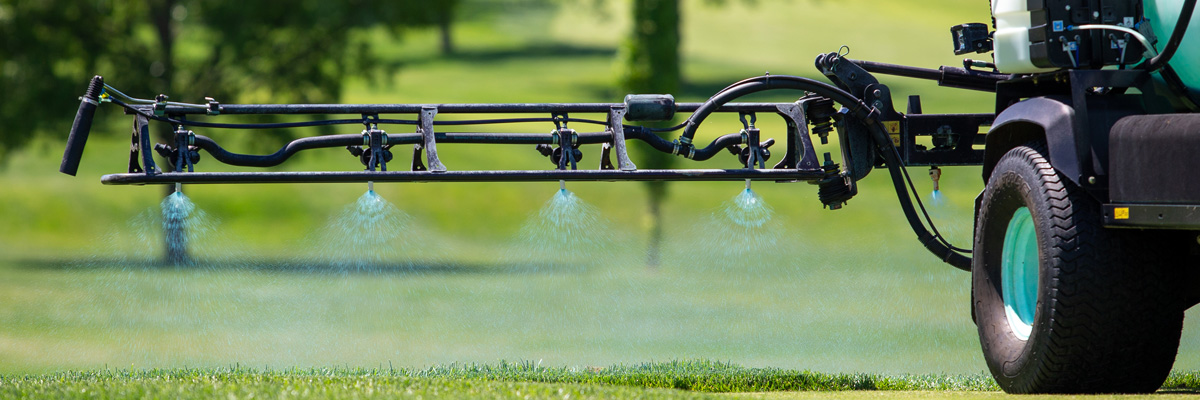
Has your morning ever been wrecked by your spray mix morphing into a gelatinous blob in your spray tank, clogging your filters, pumps, and nozzles along the way? Have you ever applied a pesticide and felt like you just didn’t get the results you were looking for? If so, you’re not alone. Getting the right mix can be downright daunting. There are so many factors to consider and so many possible combinations of products, it can be easy to get a little mixed up. Not to worry. We’ve rounded up the top five tips to keep in mind for your next spray tank fill-up.
1. Follow the mix order
When reading a product label, there are two very important pieces of information—product formulation and mix order—that you need to pay close attention to when considering how to add the product to a spray tank. The formulation of the product, such as suspended concentrate (SC) or micro emulsion (ME), provides an indication of the chemical properties of the product. Then, most labels also indicate a proper mixing order based on those product formulations. If the pesticide label you’re referencing doesn’t include this information, it’s helpful to have a reference guide, such as this Purdue University guide, readily available.
2. Monitor your tank pH
In many cases, product efficacy can be drastically influenced by carrier water and tank mix pH. A pH that’s too high or too low can cause the application you invested in to become almost entirely ineffective. It should be indicated on the product label if efficacy of the active ingredient is influenced by pH. Generally, neutral to moderately acidic carrier water will have minimal effects on active ingredient efficacy. Spray tank pH buffer solutions, like our pH Buffer, are also available to adjust the tank pH if it’s outside the desired range.
3. Conduct a jar test
Considering the wide range of products available that could find their way into a tank mix, it’s impossible for manufacturers to determine tank mix compatibility of every single product. They can provide compatibility for the most common or likely combinations, but there’s just too many possible combinations to cover them all. So, without a reference available, conducting a quick jar test is an easy way to determine if a set of products play well together in a simulated tank mix. The general idea of a jar test is to mix proportionate amounts of each product on a small scale to detect any incompatibilities between products before mixing on a large scale. While not the most convenient task, conducting a jar test can be the difference between a successful spray application and spending all day cleaning your spray rig.
4. Leave room for water in the tank
When asked to troubleshoot an incompatible spray tank mix, my first question is always “what else was in the tank?” In some cases, the response has included a list of up to 12 products! So, before you think about throwing in a baker’s dozen into one mix, keep in mind that many of the materials we mix in spray tanks are much more compatible when diluted in water as compared to concentrated amounts. For this reason, many pesticide labels suggest the spray tank should be filled halfway with water prior to adding pesticides or other spray-applied materials. As the amount of product in the spray tank increases and the amount of carrier water decreases, the amount of material the carrier water can maintain in solution is reduced, often leading to precipitation or other incompatibility.
5. Keep in mind what you’re trying to accomplish with each product
Mix products with similar use patterns. In other words, mix foliar-directed products with other foliar-directed products and soil-directed products with other soil-directed products. For example, include PrimoMAXX® with foliar fertilizers, or add fungicides targeting soil-borne pathogens to a wetting agent app. It doesn’t make sense to include PrimoMAXX®, which is foliar absorbed, with a material that needs to be irrigated in immediately following application. Nor does it make sense to include a foliar-absorbed fertilizer with a material like a fungicide targeting soil-borne pathogens, which also needs to be irrigated immediately following application. When formulating your tank mix, keep in mind how each product works best, and group similar products together to maximize spray efficacy.
These five tips are a great place to start when considering your next tank mix or when troubleshooting a failed tank mix. But if you have specific questions relating to tank mix compatibility of pesticides or Harrell’s products, don’t hesitate to reach out to your Harrell’s rep. Each Harrell’s rep has extensive field experience with tank mixes common to their region and can provide valuable tank-mix recommendations to maximize your investment while minimizing your headaches.
Related Resources

In addition to being the nation’s largest distributor of branded fungicides, herbicides, and insecticides, Harrell’s produces custom-blended fertilizers, specialty liquids, and wetting agents. Additionally, Harrell’s is the exclusive US owner, formulator, and distributor of all POLYON® branded products.
TEAM HARRELL'S
STAY EQUIPPED
Never stop learning. Access FREE continuing education courses from Harrell’s.
LET'S GROW
PRESS RELEASES
PRESS RELEASES
STAY EQUIPPED
Never stop learning. Access FREE continuing education courses from Harrell’s.
LET'S GROW