

2023 POLYON® Watermelon North Florida Grower Trials
1/29/2025 - By Dr. Tom Reed
POLYON® - 2023 North Florida Grower Trials
Study: On-Farm Projects Demonstrating Differences between Controlled-Release Fertilizer and Conventional Programs
Location: Chiefland, FL; Newberry, FL; Williston, FL
Collaborator: Bob Hochmuth (UF|IFAS NFREC); Funded by Suwannee River Water Management District and Florida Department of Agriculture and Consumer Services
Date: 2/2024 – (Trial Data Period: 3/2023-6/2023)
Conclusion
Three on-farm trials compared a pre-plant application of POLYON® controlled-release fertilizer (CRF) to the farm’s grower standard conventional (CON) program. The CON program consists of a pre-plant application followed by dozens of fertigation events during the season. There were seven farms in this study, four other locations chose a different CRF source to evaluate. POLYON® CRF commercial watermelon blends were evaluated and were custom to each grower much like their standard CON programs. Treatment blocks on the same farm received the same irrigation and management programs.
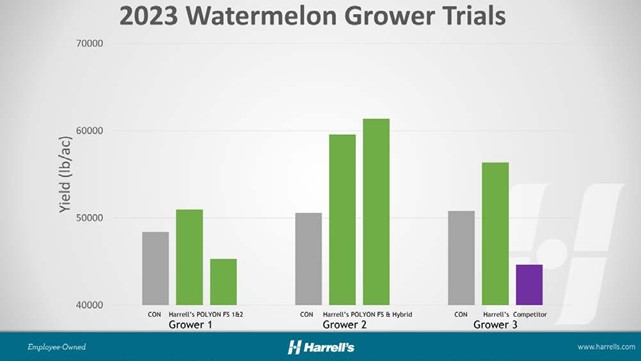
The first farm evaluated two Harrell’s POLYON® full-season blends (15-3-22 with NPK+ homogeneous product and 17-4-22 without homogeneous product). The POLYON® programs had 176 and 179 lb N/ac applied compared to 191 lb N/ac applied to the CON program. The POLYON® CRF programs had similar yields with less N applied (Figure 1). The POLYON® 15-3-22 was higher yielding and had a 5% increase in yield than the grower standard CON.
The second farm had a complete full-season POLYON® 17-3-22 and a hybrid POLYON® program with liquid in-season applications. The POLYON® programs had 169 and 160 lb N/ac applied compared to 175 lb N/ac applied to the CON program. The POLYON® CRF programs had approximately 10,000 lb/ac greater yield (20%) than the grower standard CON with less N applied (Figure 1).
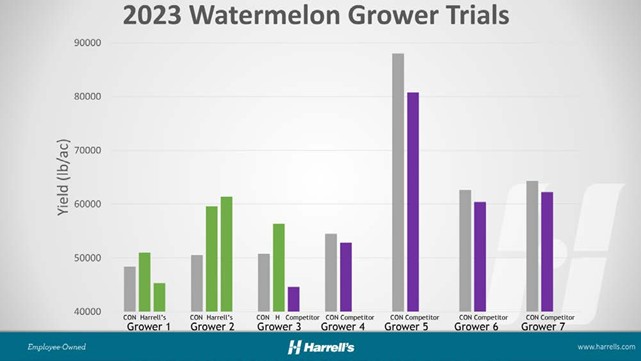
The third farm evaluated a full-season Harrell’s POLYON® CRF 17-7-21 blend against a competitor's full-season CRF blend. Harrell’s CRF program had 208 lb N/ac, the competitor CRF program had 198 lb N/ac, and the CON had 165 lb N/ac applied. The CRF programs had more N applied as the competitor CRF needed additional fertilization potentially due to releasing nutrients prematurely, and the Harrell’s CRF program was connected to the same fertigation zone. The Harrell’s POLYON® CRF program had an 11% greater yield than the grower standard CON (Figure 1). Harrell’s POLYON® CRF programs outperformed the competitor CRF programs. Competitor CRF programs always yielded less than comparative CON grower standard programs (Figure 2). Harrell’s POLYON® CRF programs performed better than competitor CRF programs and can increase yield or reduce application rates compared to CON programs.
Contact Your Harrell's Rep to Learn More
To read more of our latest product trials and stay up to date on our products and innovations, reach out to your local Harrell's Representative. They are here to answer all of your questions and help you get the maximum efficacy out of your products and crops.
Related Resources

In addition to being the nation’s largest distributor of branded fungicides, herbicides, and insecticides, Harrell’s produces custom-blended fertilizers, specialty liquids, and wetting agents. Additionally, Harrell’s is the exclusive US owner, formulator, and distributor of all POLYON® branded products.
TEAM HARRELL'S
STAY EQUIPPED
Never stop learning. Access FREE continuing education courses from Harrell’s.
LET'S GROW
PRESS RELEASES
PRESS RELEASES
STAY EQUIPPED
Never stop learning. Access FREE continuing education courses from Harrell’s.
LET'S GROW