

The POLYON® 0-0-50 Difference
11/29/2022

Potassium (K) is considered a macronutrient due to it being absorbed by plants in a greater quantity than any other nutrient except nitrogen (Havlin et al., 2005). The amount of K actually required by plants and its role therein is a debated topic of late. We do know, however, that K is required at some level. So, what is the best K source for turf management?
Potassium Deficiency Threshold Guidelines
Minimum Level of Sustainable Nutrition (MLSN) threshold guidelines define soil K deficiency as less than 37 parts per million. Relative to other cations, K is weakly held on soil cation exchange sites, making it especially susceptible to losses through leaching. Most modern putting greens are sand-based with low cation exchange capacity (CEC). A combination of low soil CEC and low cation-binding affinity is a recipe for deficient soil potassium. Soils in areas with a high annual rainfall total often have low soil K concentrations, as much of the plant-available K is lost through leaching. Whatever the reason for deficiency, here are several common options to supplement K and reasons why and why not to use each source.
Forms of Potassium
Many forms of K are available, and each has benefits and drawbacks. Understanding the characteristics of each source is the first step in maximizing the efficiency of applied K from an agronomic and financial perspective.
Sulfate of Potash 0-0-50 (SOP):
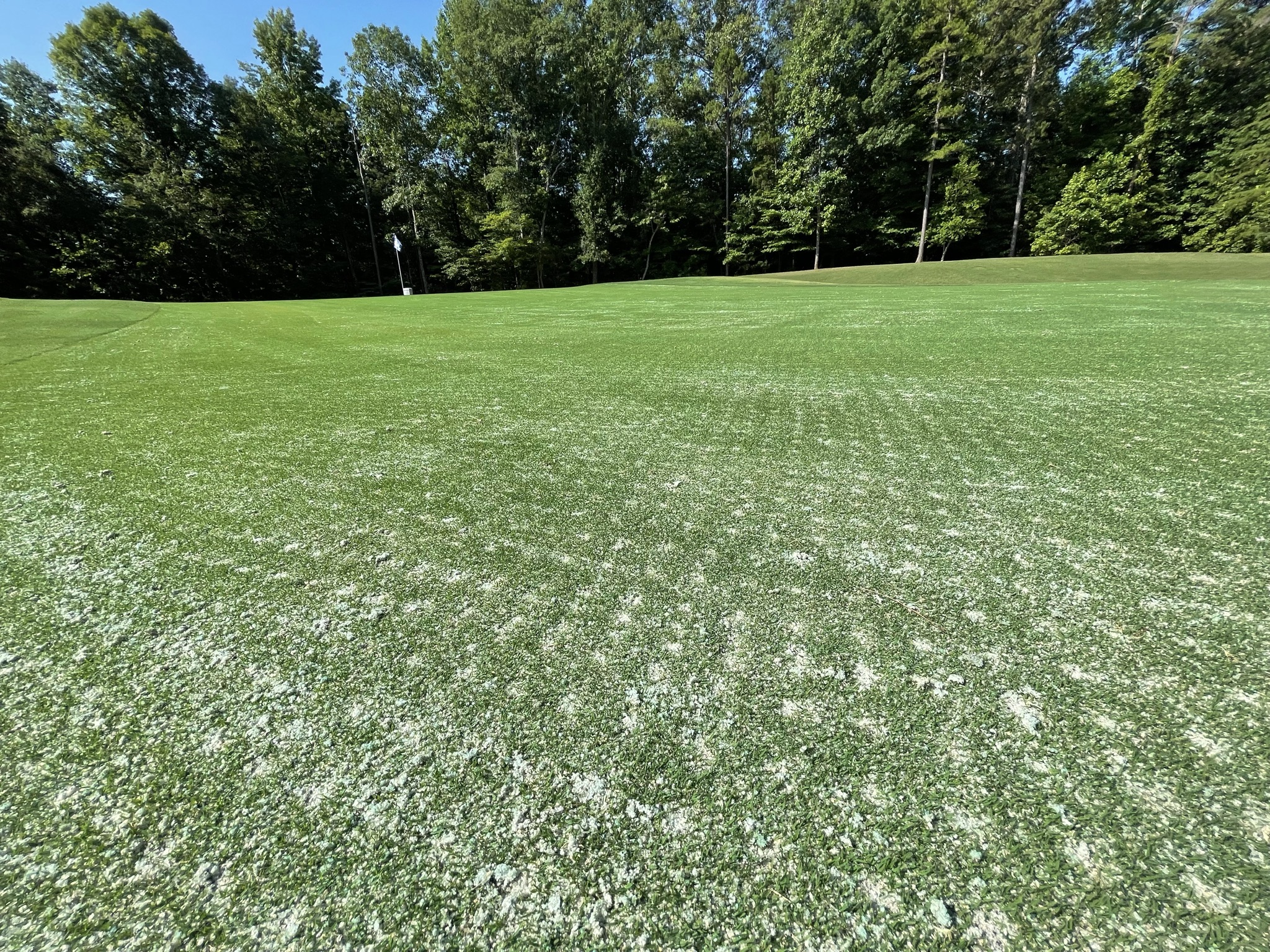
Sulfate of Potash is a desirable K source for a couple of reasons. First, SOP provides two plant essential nutrients, potassium and sulfur. Second, SOP carries a low salt index, in other words, low burn potential when applied as a granular fertilizer. As for downsides, SOP has very low water solubility and, for this reason, is an undesirable source for meltdown liquid applications compared to alternative K sources. Further, compared to MOP (below), SOP is more expensive per unit of K.
Muriate of Potash 0-0-62 (MOP):
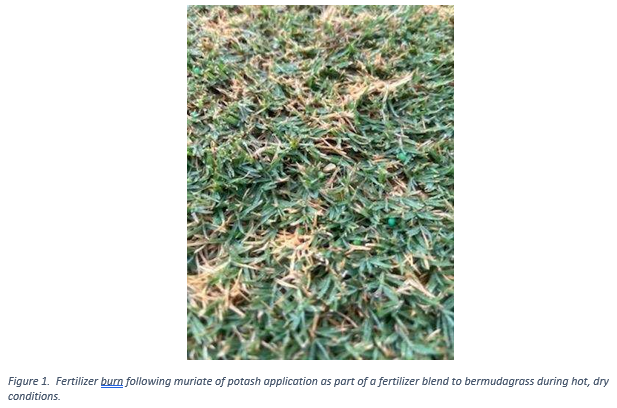
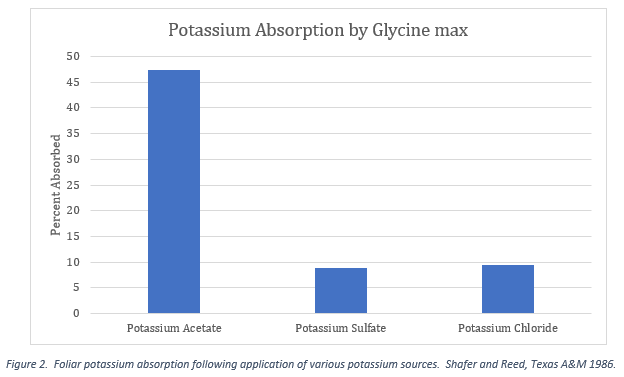
Muriate of potash is often applied as an affordable alternative to SOP in granular blends, with a couple of drawbacks. First, MOP is potassium chloride, meaning that application only supplies one plant-required nutrient, K. Second, MOP is more likely to cause fertilizer burn during hot, dry conditions due to its high salt index (Figure 1). Although MOP can be easily melted down and applied as a foliar application, the foliar uptake efficiency of MOP is extremely low compared to alternative K sources (Figure 2).
Sulfate of Potash Magnesia 0-0-22, Sul-Po-Mag, K-Mag:
As the name indicates, K-Mag is a source of potassium, magnesium, and sulfate. Although K and Mg sources are available in forms that contain a higher percentage of each respective nutrient, K-Mag is an excellent option for fertilizer blending and regular applications to sand-based greens to maintain soil K and Mg levels. Like SOP, K-Mag also provides plant-available sulfur. Financially, K-Mag is more expensive per unit of K than both MOP and SOP.
Potassium Phosphite:
Potassium phosphite is the key ingredient in Harrell’s Title Phyte® Systemic Fungicide and provides plant-available potassium and pythium control. Although the phosphite component does contain phosphorus, the phosphorus is not in a plant-available form. Title Phyte® is unique in that it carries both an 0-0-30 fertilizer label and a fungicide label. When considering ways to be more efficient with fertility and fungicide product selection and application, Title Phyte® is a great option to include in an agronomic program.
Potassium Acetate:
Potassium acetate is a readily absorbed foliar potassium source and a key ingredient in Harrell’s Stress Relefe 0-0-25. While potassium acetate does not provide disease control like potassium phosphite, it is an affordable option for readily available, foliar-applied K. Research published in 1986 by a pair of Texas A&M University researchers quantified potassium acetate foliar absorption efficiency to be greater than 45% and potassium sulfate and muriate of potash to be less than 10% (Figure 2). The research indicates that lower foliar application rates of potassium acetate can result in the same amount of total foliar potassium absorption compared to higher application rates of SOP and MOP.

POLYON® 0-0-50
While the granular K sources described so far all provide plant-available K, they each have a significant drawback. Because potassium is a highly leachable nutrient, the increase in soil K content following the application of these materials is temporary.
Soil K concentration will drop as plants absorb available K, and excess K leaches through the soil profile via irrigation and rainfall. Consistent plant K availability and minimized leaching can be achieved by applying a controlled-release potassium source such as POLYON® SOP 0-0-50. Depending on location and application rate, POLYON® SOP 0-0-50 can provide up to 20 weeks of controlled-release K. See more of POLYON® here.
POLYON® 0-0-50 Application Program
A common POLYON® SOP 0-0-50 application program is to apply 4-6 lbs of product (2-3 lbs K) per 1000 sq. ft. during spring or early summer aerification. If soil incorporation during aerification is not possible, lower-rate applications – 2 lbs per 1000 sq. ft., followed by brushing and irrigation – can also serve as a way to incorporate POLYON® SOP 0-0-50 into the soil profile. A third idea is to apply POLYON® SOP 0-0-50 after needle tine aerification anytime throughout the year. Because the SOP substrate is polymer-coated, the potential for fertilizer burn following application is practically zero.
POLYON® Performance and Consistency
In recent years, Harrell’s has taken steps to improve POLYON® SOP 0-0-50 performance and consistency. As with many things, quality in equals quality out, and this is especially true with coated fertilizers. As a general rule, the rounder and more consistent a nutrient substrate is, the more suitable it is as a substrate for polymer coating.
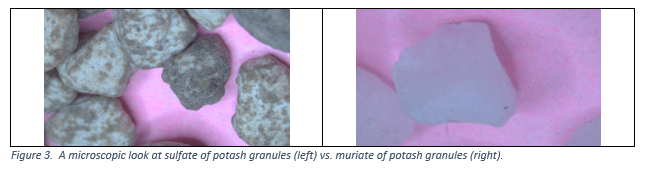
Regarding potassium sources, SOP tends to be less angular than MOP, translating into more consistent POLYON® coating characteristics and improved release characteristics for SOP. Harrell’s makes every effort to source and coat the highest quality substrates for POLYON® SOP 0-0-50. Further, Harrell’s continues to invest in upgrades to the POLYON® coating facility to improve the quality and consistency of all POLYON® products.
Finally, Harrell’s employs a dedicated R&D team whose complete focus is improving POLYON® manufacturing quality and consistency. As always, every POLYON® batch is held in quarantine until the batch can be tested and determined to perform within tightly controlled release specifications.
Contact Your Harrell’s Rep for POLYON®
As with POLYON® nitrogen sources, Harrell’s proprietary POLYGRAPH® Software can be utilized to predict potassium release following POLYON® SOP 0-0-50 application. Reach out to your Harrell’s Territory Manager for ideas on how POLYON® SOP 0-0-50 is used in your area and how Polygraph predicts potassium release for your specific agronomic scenario.
References:
Havlin, JL, JD Beaton, SL Tisdale, WL Nelson. 2005. Soil Fertility and Fertilizers, an Introduction to Nutrient Management. Pearson Education, Inc. Upper Saddle River, NJ.
Shafer, WE, DW Reed. 1986. The foliar absorption of potassium from organic and inorganic potassium carriers. Journal of Plant Nutrition 9:143-157
Related Resources

In addition to being the nation’s largest distributor of branded fungicides, herbicides, and insecticides, Harrell’s produces custom-blended fertilizers, specialty liquids, and wetting agents. Additionally, Harrell’s is the exclusive US owner, formulator, and distributor of all POLYON® branded products.
TEAM HARRELL'S
STAY EQUIPPED
Never stop learning. Access FREE continuing education courses from Harrell’s.
LET'S GROW
PRESS RELEASES
PRESS RELEASES
STAY EQUIPPED
Never stop learning. Access FREE continuing education courses from Harrell’s.
LET'S GROW