

Soil Wetting Agents: Agents of Control and More!
5/10/2022 - By Dr. Raymond Snyder

Turf managers want control of water. That's a fact. They want the ability to control both the necessary water inputs and the movement of water in the soil. The ability to control water has implications on turfgrass health, playing conditions, and resource management.
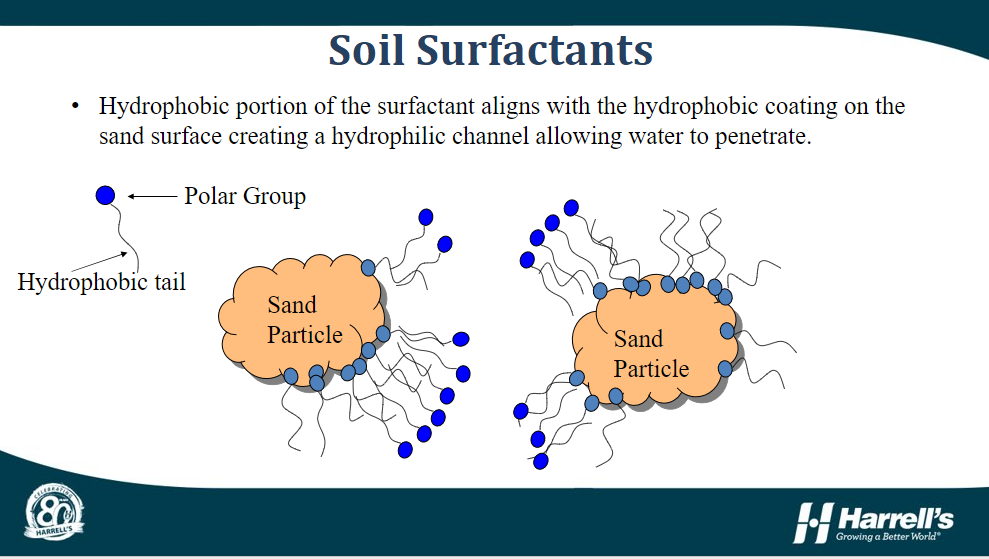
Wetting agents at a minimum should alleviate soil water repellency. Alleviating soil water repellency helps promotes uniform infiltration of rainfall and irrigation. Undesired “fingered flow” can result when soil water repellency is not corrected (see photo).
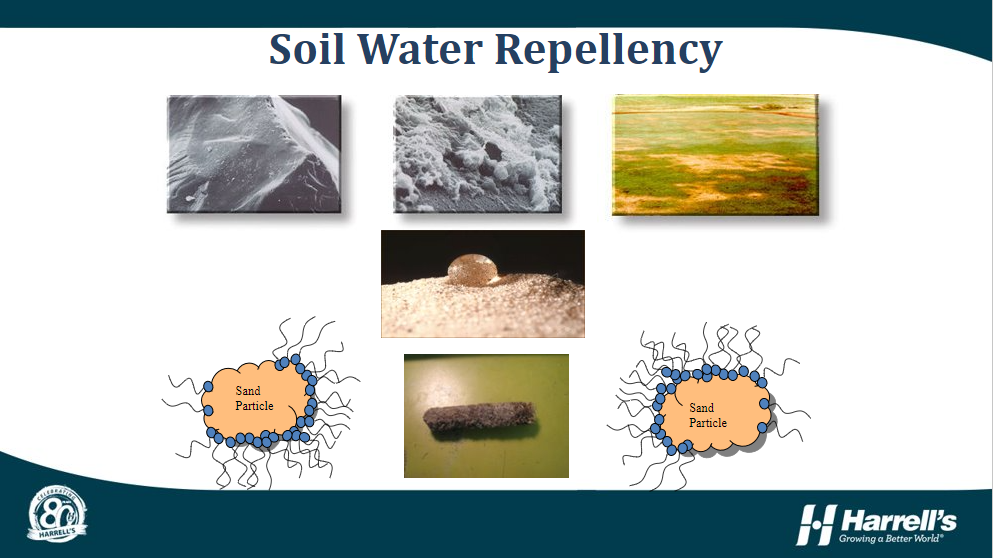
Localized dry spots (LDS) are visual turf symptoms that hydrophobic and underlying soil water repellency exist in the soil profile (see photo).
Beyond fulfilling the most fundamental role in alleviating soil water repellency, wetting agents can have an impact on other desirable effects, such as turf quality and surface playability. Recent field studies by Dr. Zhang at Virginia Tech determined that monthly applications of Fleet®100 increase turf quality, color, photochemical efficiency, and root biomass in a bentgrass putting green.
Dr. Marco Schiavon at the University of Florida conducted a field trial on ‘TifEagle’ bermudagrass and observed increased turf quality, increased surface firmness, and lower soil volumetric water content as a result of monthly Fleet®100 applications. Especially in conjunction with the addition of weekly Activator + SA applications.
In summary, turf managers can harness the power of water in a turfgrass setting using wetting agents thereby maximizing the agronomic value of water and improving turfgrass playability. For more information on wetting agents and which will be right for your turf, reach out to your local Harrell's Rep!
Related Resources

In addition to being the nation’s largest distributor of branded fungicides, herbicides, and insecticides, Harrell’s produces custom-blended fertilizers, specialty liquids, and wetting agents. Additionally, Harrell’s is the exclusive US owner, formulator, and distributor of all POLYON® branded products.
TEAM HARRELL'S
STAY EQUIPPED
Never stop learning. Access FREE continuing education courses from Harrell’s.
LET'S GROW
PRESS RELEASES
PRESS RELEASES
STAY EQUIPPED
Never stop learning. Access FREE continuing education courses from Harrell’s.
LET'S GROW