

Poa annua Management Program Considerations
1/12/2024 - By Dr. Jeff Atkinson
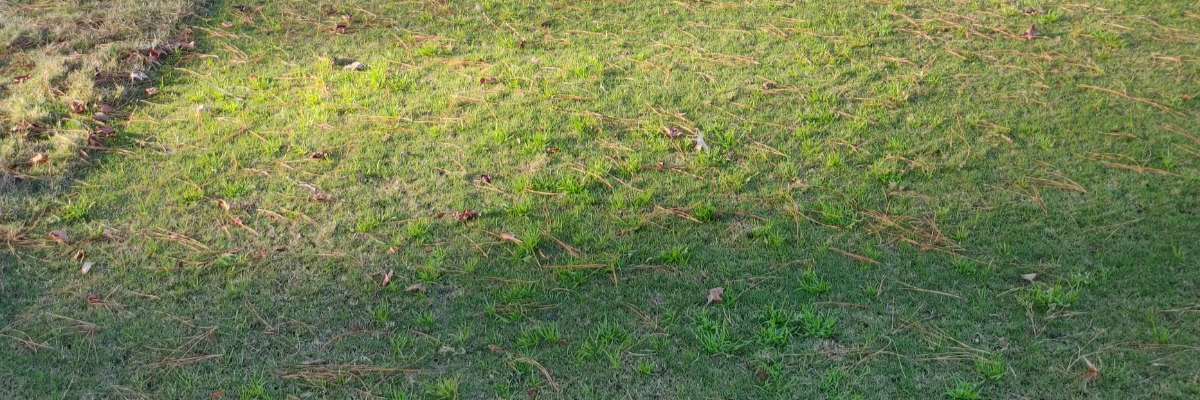
Poa annua is a dynamic weed. Herbicide selection, application timing, and environmental
conditions at the time of application can all influence the effectiveness or
ineffectiveness of a P. annua preemergence program.
Poa annua Has Arrived - What to Do Now?
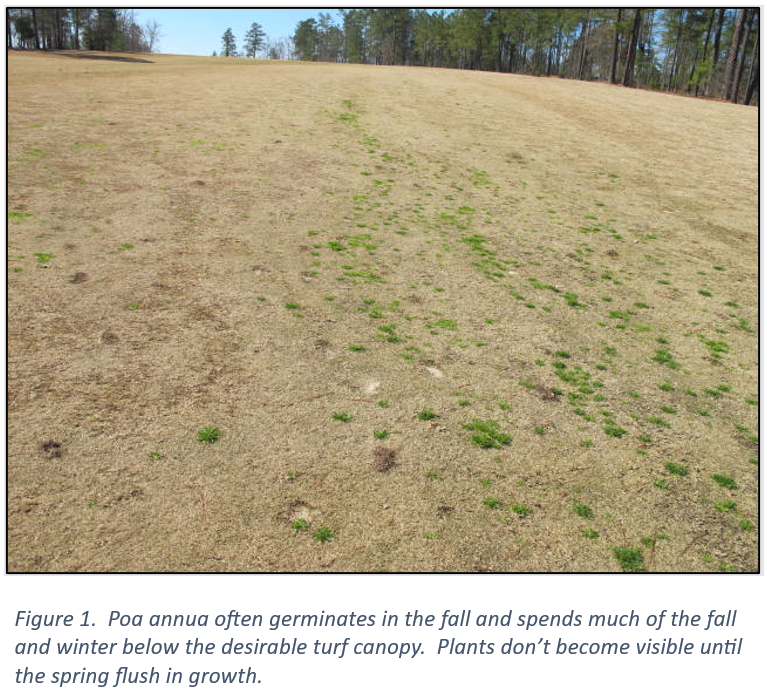
To the misfortune of the turf manager, P. annua, which is not controlled by fall preemergence herbicide applications, is often not visible until the spring when they break through the turf canopy.
Poa annua Biology
The first step to any effective
pest control program is understanding the pest’s biology. Although more
resources are dedicated to Poa annua research in turfgrass programs
across the United States than any other weed, there are still a lot of things
about P. annua we don’t have concrete answers on.

However, through significant
federal funding commitments via the Resist Poa - USDA-SCRI Annual Bluegrass Collective, and the dedication of university
researchers across the United States, we are learning more about germination
and establishment patterns, prevalence and distribution patterns of herbicide
resistance, and effective control strategies.
One key to appreciating the
difficulty of P. annua management is understanding the genetic
‘flexibility’ of the species. In fact, P.
annua can be found on all continents, including Antarctica! This extreme
adaptability is a result of a large genetic library contained within each P.
annua plant derived from the parent species Poa supina, which is a
cool-season perennial species native to the cool, moist European Alpine
region, and Poa infirma, which is a cool-season perennial species
native to dry, Mediterranean climates in Europe (Mao and Huff, 2012).
For turf managers, this translates
into a weed with a long germination window, is not easily controlled by adverse environmental conditions, and rapidly develops resistance to herbicides when frequently applied without rotation.
Four key P. annua biology characteristics are important
considerations when building a Poa annua management program:
·
The majority, but not all, Poa annua
germinates in the fall in temperate regions.
·
Poa annua becomes less physiologically
active as temperatures cool.
·
Poa annua is a prolific seedhead producer.
·
Herbicide resistance is real,
and is not going away.
Here is a look into each of these
a little closer:
Poa annua Germination
Observation suggests Poa annua
has a wide germination window, however a debate continues about how much
germination occurs in temperate climates during the fall months versus how much
germination occurs in the spring as temperatures warm. Recent research at the University of Tennessee aimed to answer this question (Taylor et al., 2021).
The researchers found through two
years of data collection in the Knoxville, TN region that P. annua emergence
changed most rapidly between the 40th and 43rd week of
the year when seven-day mean soil temperature and rainfall were 66F and 0.5
inches, respectively, even though initial emergence occurred on September 4th
in 2019 and August 5th in 2020, a full month earlier.
Since we know when the majority of
Poa annua germinates, control should be easy, right? Wrong.
Unfortunately, the keyword is
‘majority’ as a percentage of P. annua can germinate in the warming
spring months. This extremely long
germination window pushes the limits of the residual efficacy of fall-applied preemergence
herbicides such as prodiamine (Barricade, Syngenta) and indaziflam (Specticle,
Envu) (Cross, 2014).
Poa annua Becomes Less Physiologically Active as
Temperatures Cool
Many systemic herbicides require
physiological activity to maximize efficacy.
One common example of Poa annua management is the relatively
poor control achieved by sulfonylurea (SU) herbicides when temperatures
cool. Examples of SU herbicides include
flazasulfuron (Katana, PBI Gordon), trifloxysulfuron (Monument, Syngenta), and
foramsulfuron (Revolver, Envu).
Sulfonylurea herbicides work by inhibiting a plant’s ability to produce
essential amino acids which serve as the building blocks of proteins and facilitate other vital plant functions.
Without these amino acids,
sensitive plants lose the ability to function over time and ultimately
die. However, under cool temperatures P.
annua’s need for these essential amino acids is drastically lower, allowing
time for the plant to detoxify the herbicide active ingredient, recover, and
resume normal growth. Sometimes this can
be observed in the field as a growth regulation effect of P. annua, or
other target weeds followed by resumption of normal growth when plant death was
the expected outcome.
During this time, contact
herbicides should be considered. Active
ingredients such as diquat (Reward, Syngenta), glufosinate (Cheetah Pro, Nufarm), and flumioxazin (Sureguard®, Nufarm) should be considered. These materials do not rely as much on
physiological activity to be effective.
However, they are non-selective
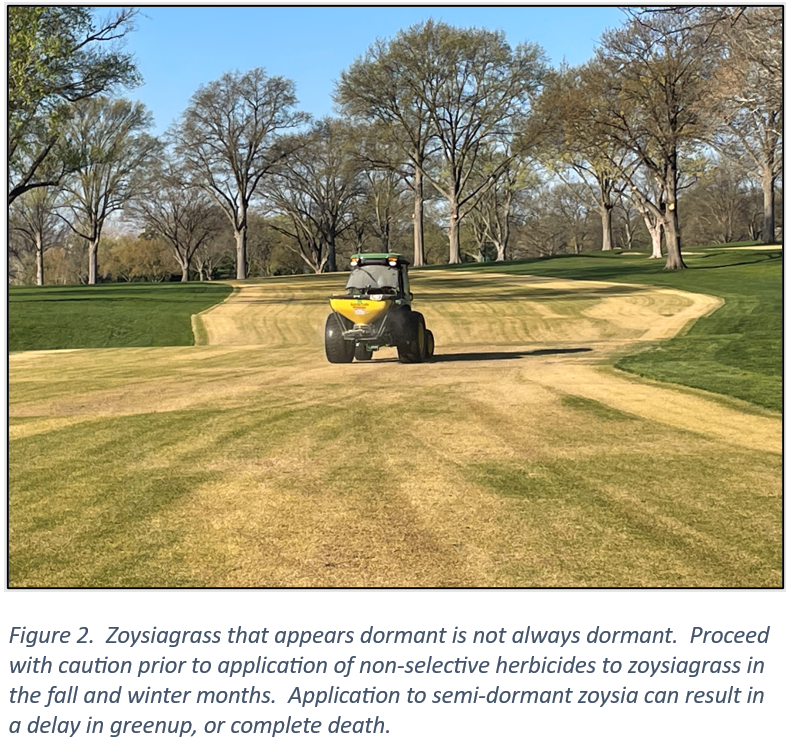
and therefore should only be applied to dormant desirable turf. In many regions of the transition zone,
bermudagrass is fully dormant through the winter season. Apply with caution to zoysiagrass, especially
in more southern regions, as zoysia often appears dormant while further
investigation in the canopy reveals green, non-dormant stolons and rhizomes. These plant parts can be negatively affected
by herbicide applications, leading to a delay in spring greenup at best or plant
death at worst.
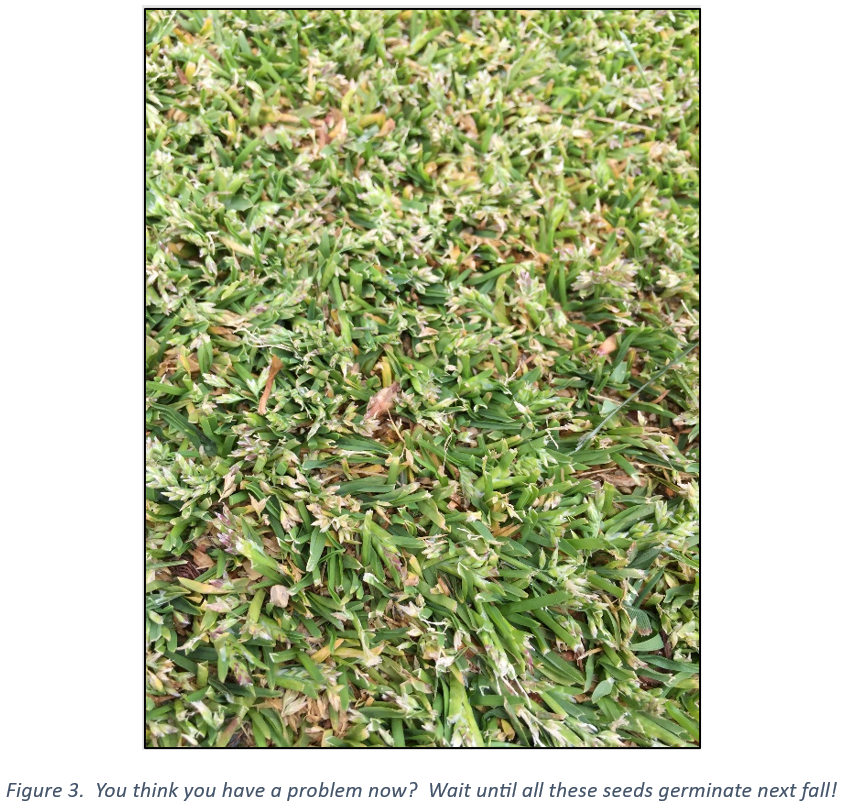
Poa annua is a Prolific Seedhead Producer
It’s true that in many areas of
the Southern United States, unsightly Poa annua infestations will
eventually go away as the summer season arrives. As temperatures warm and mowing frequency
increases, summer stress will cause the remaining P. annua plants to melt
away. Following this strategy, however, only makes the problem worse for next
fall.
Estimates suggest that annual P.
annua biotypes are capable of producing up to 2,250 seeds per plant in a
single season and that the surface layer of soil could contain up to 7,500
seeds per square meter (Holm et al., 1997 and Renney, 1964)! If Poa annua
is allowed to grow, develop, and seed, the prolific seeding nature of P.
annua is setting the stage for a more severe infestation the following
year. For this reason, taking measures to maximize control before the major
spring seedhead flush is an important step to managing future infestations.
Poa annua Herbicide Resistance is Real, and Not Going Away
Unfortunately, in part due to Poa
annua’s flexible genetics and in part due to our overuse of single-mode-of-action herbicides, herbicide resistance is increasing in prevalence. In many
cases, P. annua resistance to multiple modes of action is present in a
single population, rendering several herbicide modes of action ineffective at
controlling a population at a single location.
Models have demonstrated that
herbicide rotation and combination of herbicides with different modes of action
is an effective strategy to delay the development of herbicide resistance. Too
often we as an industry become creatures of habit. We find something that works
and stick with it. Proceed with caution using this mindset, as what works today
will not work tomorrow if it is used year after year after year.
Poa annua Management
There’s no getting around it, nor
a silver bullet for it. Poa annua management is tough. Your local Harrell's Representative is well-versed in effective P. annua control strategies for your area and is your best resource to improve your program using
strategies that work on a local level.
Looking for more reading material
on the subject? Consider these past blog posts:
Annual Bluegrass (Poa annua) Control Using Fertilizer with StayGuard 0.125%
Achieving More Consistent Control of Poa annua Seedheads
Poa annua Management in Dormant Bermudagrass -- What's the Answer?
References:
Cross, R. 2014. Ecological, Physiological, and Molecular
Characterization of Annual Bluegrass (Poa annua L.) Herbicide Resistance and
Its Control on Golf Courses. All
Dissertations. 1431. https://tigerprints.clemson.edu/all_dissertations/1431. Accessed 8 December 2023.
Holm, L.G. 1997. World Weeds: natural histories and
distribution. J. Wiley, New York.
Mao, Q., and D.R. Huff. 2012.
The evolutionary origin of Poa annua L. Crop Sci.
52:1910-1922.
Renny, A.J. 1964. Preventing Poa annua
infestations. Proc. Northwest Turf.
Conf. 18:3-5.
Tayor, D.R., M. Prorock, B.J. Horvath, and J.T. Brosnan. 2021. Modeling seasonal emergence of Poa annua in urban greenspace.
Related Resources

In addition to being the nation’s largest distributor of branded fungicides, herbicides, and insecticides, Harrell’s produces custom-blended fertilizers, specialty liquids, and wetting agents. Additionally, Harrell’s is the exclusive US owner, formulator, and distributor of all POLYON® branded products.
TEAM HARRELL'S
STAY EQUIPPED
Never stop learning. Access FREE continuing education courses from Harrell’s.
LET'S GROW
PRESS RELEASES
PRESS RELEASES
STAY EQUIPPED
Never stop learning. Access FREE continuing education courses from Harrell’s.
LET'S GROW