

Phytophthora, the Summertime Plant Destroyer
6/27/2023 - By Dr. Aaron Palmateer

Just like the people who enjoy the warm and sunny weather that
summer brings, plants also thrive during this time of year. Warmer temperatures
with frequent rain events are favorable for plant growth, but these conditions
are also highly favorable for disease-causing pathogens, most notably for phytophthora.
Those conditions make preventative disease management a priority, especially
for commercial greenhouse and nursery operations with a high density of plant
material.
Phytophthora Plant Disease
Some plant pathogens, especially those that thrive during warm and
wet weather, are introduced into the greenhouse or nursery through the water. In
fact, some of the costliest plant diseases are caused by a group of fungal-like
pathogens called Oomycetes. The common name for Oomycetes is “the water molds.”
The most infamous is Phytophthora infestans, which was the causal agent
of the Irish
potato famine.
The name of the genus Phytophthora is derived from Greek
and means phyto (plant) and phthora (destroyer), giving some inclination to the
severity of plant diseases caused by species of Phytophthora.
More like fungi than other pathogens (i.e., bacteria, nematodes,
and viruses), the water molds are more closely related to brown algae than true
fungi. Though they have the capability of being introduced into a greenhouse or
nursery through water (i.e., irrigation water, splashing, windblown rain), most
species have adapted to living in moist environments by producing spores with flagella
that enable them to swim. Thus, the spores can move readily in free water within
the soil and on plant surfaces, often resulting from irrigation, rain, fog, or
dew.
How to Spot Phytophthora
Phytophthora plant disease species are known to cause root rots,
stem and crown rots, cankers, and aerial blights. Warm, humid, and wet
conditions are highly favorable for Phytophthora, and we often see symptoms of
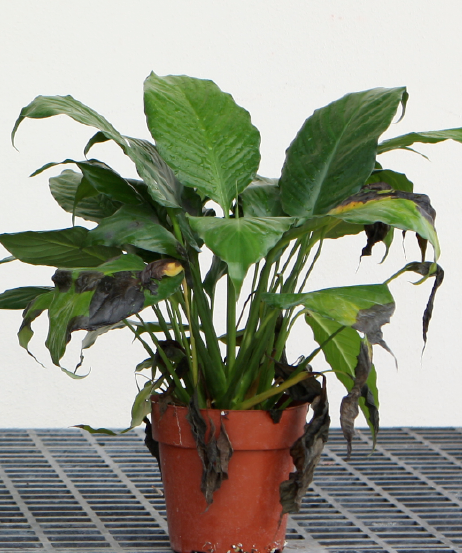
the disease above ground. For example, Phytophthora blight on Spathiphyllum
(peace lily) begins on the leaves and flowers, which become necrotic and
blighted. And the stem-like petioles become discolored and wilted as the
disease progresses downward. In advanced stages, dark brown to black leaf
petioles collapse, resulting in death, however, the roots of diseased plants
often remain healthy.
Prevention of Phytophthora Plant Disease
Wet conditions favor Phytophthora, and overwatering and saturated
conditions often lead to disease. Both field-grown and containerized plants are
more likely to be affected by Phytophthora in nurseries prone to flooding. Due
to the moist environment, propagation houses and plants on mist benches are
highly susceptible. Sanitation is a must in production areas of the nursery or
greenhouse:
-
Carefully inspect plugs or newly introduced
plant material and reject if any symptoms are present.
-
Space plants apart to allow as much air
movement as possible to hasten leaf drying after irrigation or rainfall.
-
Sanitize hard surfaces in the growing area
with disinfectants.
-
Remove all diseased plant tissue (especially
leaf tissue) and dispose of it offsite.
Like many plant pathogens, Phytophthora is a soilborne organism
that resides in the ground or natural field soils, making the use of ground cloth and other physical barriers
important. Any area that is exposed to bare ground can potentially be a source
of Phytophthora, especially when prone to flooding. It’s not uncommon to see
plants that have fallen over where the leaves touch bare ground or standing
water, become infected and then when stood upright serve as the source of inoculum
for an outbreak of Phytophthora blight.
Chemical Control of Phytophthora Plant Disease
Your Harrell's Representative can help you to formulate the perfect plan for prevention in
your plants. In the below table, you can find a few product recommendations and
application rates/intervals so you can start your prevention regimen today.

Also, consider the powerful new fungicide Harrell's ProtectMAX® Fluoxastrobin SC (FRAC 11) for your rotation.
Final Thoughts
The disease can move swiftly through a plant canopy and it’s not
uncommon to see significant damage occur over a single night or two. Thus, fungicides are highly recommended for managing Phytophthora plant disease and a
preventative program should be in place, especially during the summer months
when conditions are most favorable for diseases.
When
applying any pesticide, always refer to the manufacturer’s label for
recommended rates and application intervals.
As always, if you have any further questions regarding
disease, diagnosis, product recommendations, or prevention strategies, you can
reach out to your local Harrell's Rep
for assistance.
Related Resources

In addition to being the nation’s largest distributor of branded fungicides, herbicides, and insecticides, Harrell’s produces custom-blended fertilizers, specialty liquids, and wetting agents. Additionally, Harrell’s is the exclusive US owner, formulator, and distributor of all POLYON® branded products.
TEAM HARRELL'S
STAY EQUIPPED
Never stop learning. Access FREE continuing education courses from Harrell’s.
LET'S GROW
PRESS RELEASES
PRESS RELEASES
STAY EQUIPPED
Never stop learning. Access FREE continuing education courses from Harrell’s.
LET'S GROW